Supreme Court Senior Advocate Designation Guidelines 2026
 Copy Link
 Share
Share Save
Save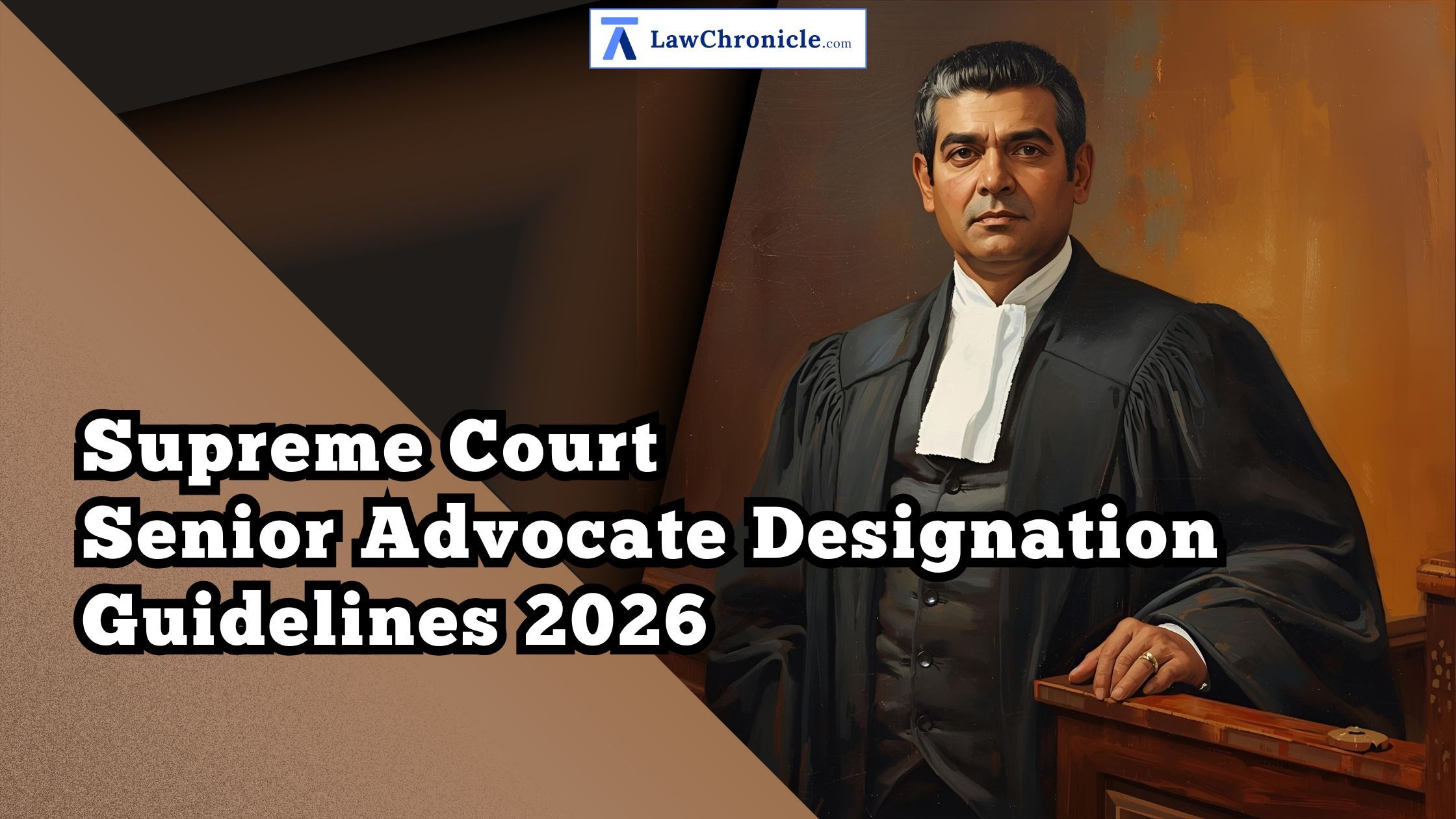
The Supreme Court of India issued a notification on 11th February, 2026, announcing new rules governing the designation of Senior Advocates. The move follows the Court’s decision dated May 13, 2025, in Jitender @ Kalla vs. State (Govt. of NCT of Delhi) and Anr. (2025).
In a Full Court meeting held on February 10, 2026, the Chief Justice of India and other judges approved the new framework titled “Guidelines for Designation of Senior Advocates by the Supreme Court of India, 2026.” These replace the 2023 guidelines and introduced some changes in the Senior Advocate designation process, as discussed below.
Permanent Committee to Oversee Designation
Composition and Functioning
All matters relating to the Supreme Court Senior Advocate designation process will be handled by a Permanent Committee called the “Committee for Designation of Senior Advocates”. The Committee will consist of:
- Chief Justice of India – Chairperson
- Two senior-most Judges of the Supreme Court – Members
The Committee will meet as required. A Permanent Secretariat will assist it. The composition of the Secretariat will be decided by the Chief Justice of India in consultation with Committee members.
Application Process
Annual Invitation of Applications
The Secretariat will initiate the process at least once a year. Applications will be invited through a notice published on the official website of the Supreme Court of India. Intimation will also be given to the Supreme Court Bar Association (SCBA) and the Supreme Court Advocates-on-Record Association (SCAORA). Applicants will be given at least 21 days to submit applications online in the prescribed format.
Stakeholder Consultation
After receiving applications, the Secretariat will compile relevant information regarding reputation, conduct, and integrity. Proposals will be published on the official website. Stakeholders will have at least 15 days to submit suggestions or views.
Eligibility Criteria
Under the new supreme court senior advocate designation rules, an applicant must:
- Have at least 10 years’ standing as an Advocate; or
- Have 10 years’ combined standing as an Advocate and as a District and Sessions Judge or Judicial Member of a Tribunal with prescribed qualifications.
- Practice mainly in the Supreme Court.
- Have attained 45 years of age, unless relaxed by the Full Court.
- Not have had an application rejected within the past two years or deferred within the past one year.
Applicants must also have no criminal conviction involving moral turpitude or contempt of court, and no misconduct findings by Bar Councils.
Assessment Criteria
The Full Court will assess candidates based on:
- Ability, including legal knowledge and advocacy skills
- Standing at the Bar
- Special knowledge or experience in law
- Professional ethics and integrity
The decision will be by consensus. If consensus is not possible, it will be by majority. Secret ballot may be used in exceptional cases with recorded reasons.
Former High Court Judges
As per Supreme Court senior advocate designation rules, former Chief Justices and Judges of High Courts may submit a request-cum-consent letter. Those holding full-time assignments will not be considered during that period.
Review and Communication
Applications not favourably considered will be reviewed after two years. Deferred cases will not be reconsidered for one year. Final decisions will be communicated individually. The Full Court may also recall the designation if the advocate is found guilty of conduct that disentitles them from being among the senior advocates designated by Supreme Court. All interpretational issues will be decided by the Chief Justice of India.
 Breaking News