

SC Lays Down Clear Benchmarks for Dying Declarations in Dowry Death Cases
 Copy Link
 Share
Share Save
Save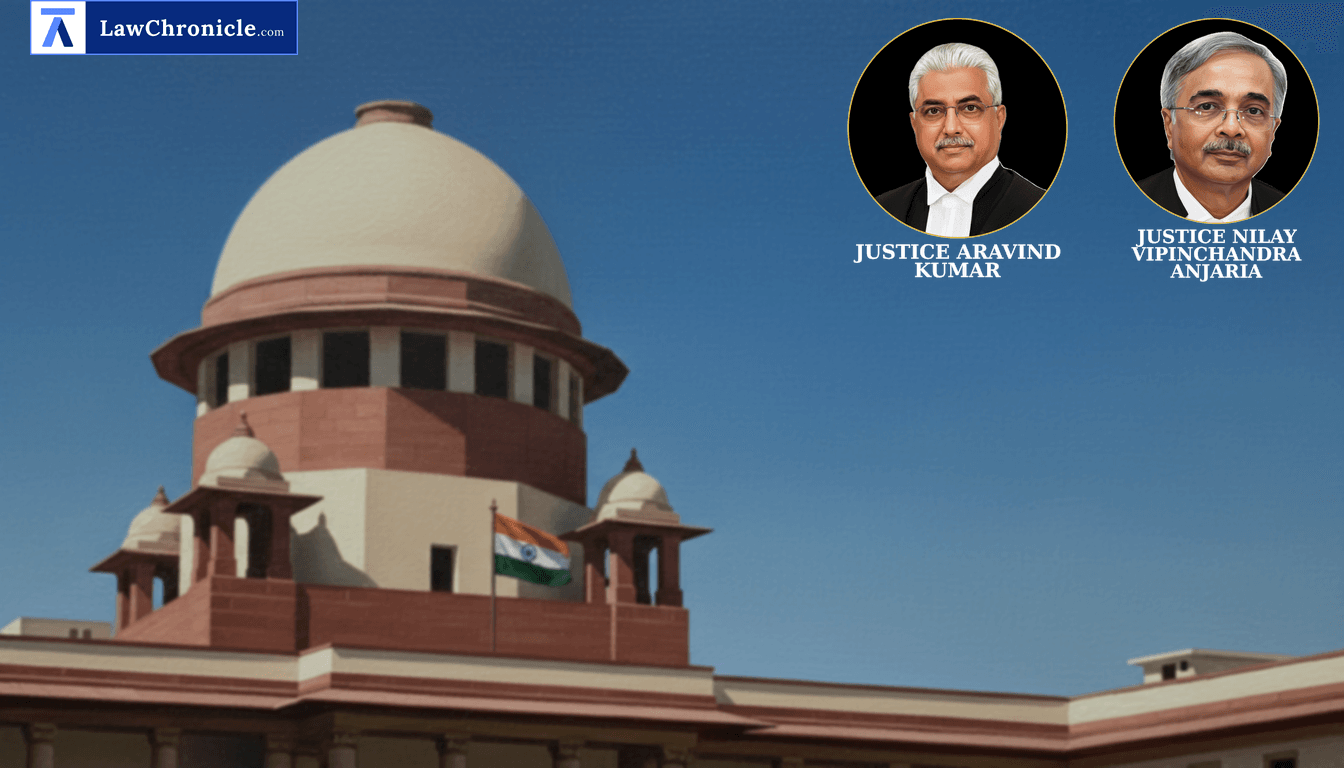
The Supreme Court of India in Narendra Singh v. State of Madhya Pradesh held that although a conviction may rest solely on a dying declaration, such a declaration must still be carefully evaluated in light of the surrounding circumstances and the principles governing prosecution evidence. The Court noted a material inconsistency between the two dying declarations: the first stated that the in-laws had set the deceased on fire, whereas the second stated that the deceased had set herself ablaze. Reiterating settled law, the Court emphasised that suspicion or circumstances cannot substitute proof, and that guilt in a criminal trial must be established beyond reasonable doubt.
A bench of Justice Aravind Kumar and Justice N.V. Anjaria heard appeals arising from a High Court order that had set aside convictions for murder while upholding convictions under Section 498A of the Indian Penal Code, 1860, and the Bench heard challenges to the acquittal and conviction arising from events that occurred within nine months of marriage involving alleged burn injuries to the deceased woman and subsequent dying declarations.
The Court summarized its decision by allowing the appeal of the father-in-law and setting aside his conviction under Section 498A of the Indian Penal Code, 1860, while dismissing the appeals filed by the brother of the deceased and the State which had challenged the High Court’s acquittal under Section 302 of the Indian Penal Code, 1860. The Court emphasised the need to weigh dying declarations in the light of surrounding circumstances and to apply established principles of circumstantial evidence before drawing adverse conclusions against extended family members.
The Court, in its reasoning, observed: "Thus, in a criminal trial, in case there are two inferences possible, then the one favouring the accused must be followed. Herein, no direct evidence was produced by the prosecution on record to implicate the father-in-law for mental cruelty, or to show that he was somehow directly involved in torturing the deceased or raising the demand for dowry. It seems that the father-in-law was roped in the present matter by an extension of roping the husband of the deceased, as is the case in certain S. 498A matters. This Court has time and again issued directions in order to ensure that there is no misuse of this law, which was purported by the legislature as a tool to ensure the safety of women in their marital homes and not to take grudges against all the members of the family even in the absence of any role attributable to them."
Decision makers also noted: "The variation in the two dying declarations in the manner she died casts doubt on their veracity, but we find the second declaration more believable than the first one because it appears that the first one was recorded after the deceased was tutored to give statement in a particular manner." The Court recorded that the first dying declaration, recorded on 16.04.2001, accused the husband and in-laws of setting the victim on fire, while a subsequent dying declaration recorded on 17.04.2001 stated that the deceased had poured kerosene on herself and self-immolated; the trial and High Court treatment of those statements formed the core of the dispute.
Background
The appeals arose from charge-sheeting and trial for offences including Section 302 and Section 498A of the Indian Penal Code, 1860 and allegations under Sections 3 and 4 of the Dowry Prohibition Act, 1961. FIR was registered after two dying declarations and medical reports showing ante-mortem burn injuries; the prosecution relied on family witnesses whose statements under Section 161 of the Code Of Criminal Procedure were found to contain omissions and improvements when compared with their trial testimony. The Sessions Court convicted the accused of offences including Section 302 and Section 498A of the Indian Penal Code, 1860, but the High Court set aside the murder conviction while sustaining convictions under Section 498A and reducing sentences to the period already undergone. The Bench scrutinised the evidentiary value of the dying declarations in the light of precedent, relied upon Khushal Rao v. State of Bombay ( "1957 SCC OnLine SC 20": 1957 CaseBase(SC) 18) to restate the principles governing dying declarations, applied the panchsheel principles from Sharad Birdhichand Sarda v. State of Maharashtra ( "(1984) 4 SCC 116": 1984 CaseBase(SC) 194) to the circumstantial evidence, and invoked the cautionary note in State of U.P. v. Ashok Kumar Srivastava about completing all links in a circumstantial chain.
The Court observed that the prosecution had not produced independent corroboration for the dowry demand or direct evidence implicating the father-in-law, and that improvements in examination-in-chief vis-à-vis Section 161 statements in the record cast doubt on the reliability of interested witnesses. Given that two inferences were reasonably open on the record, the Court adopted the inference favourable to the accused, allowed Criminal Appeal No. 302 of 2014, set aside conviction under Section 498A of the Indian Penal Code, 1860 against Narendra Singh, and dismissed Criminal Appeal Nos. 309 of 2014 and 307 of 2014.
The judgment explained how Khushal Rao v. State of Bombay ( "1957 SCC OnLine SC 20": 1957 CaseBase(SC) 18) was relied on to frame the approach to dying declarations, how Sharad Birdhichand Sarda v. State of Maharashtra ( "(1984) 4 SCC 116": 1984 CaseBase(SC) 194) was applied to test the chain of circumstantial evidence, and how State of U.P. v. Ashok Kumar Srivastava was used to emphasise caution in drawing inferences on circumstantial material. The Court further noted that medical evidence showed ante-mortem burns and cause of death but that medical causation alone could not resolve conflicting versions about culpability without reliable corroboration. No interim directions beyond the judgment outcome were recorded.
Case Details:
Case No.: CRIMINAL APPEAL NO. 302 OF 2014
Case Title: Narendra Singh v. The State of Madhya Pradesh
Source: 2026 CaseBase(SC) 375
 Breaking News