

SC Sets Aside Gang Labourers Scheme; Directs Regularisation of ISRO Daily Wage Workers
 Copy Link
 Share
Share Save
Save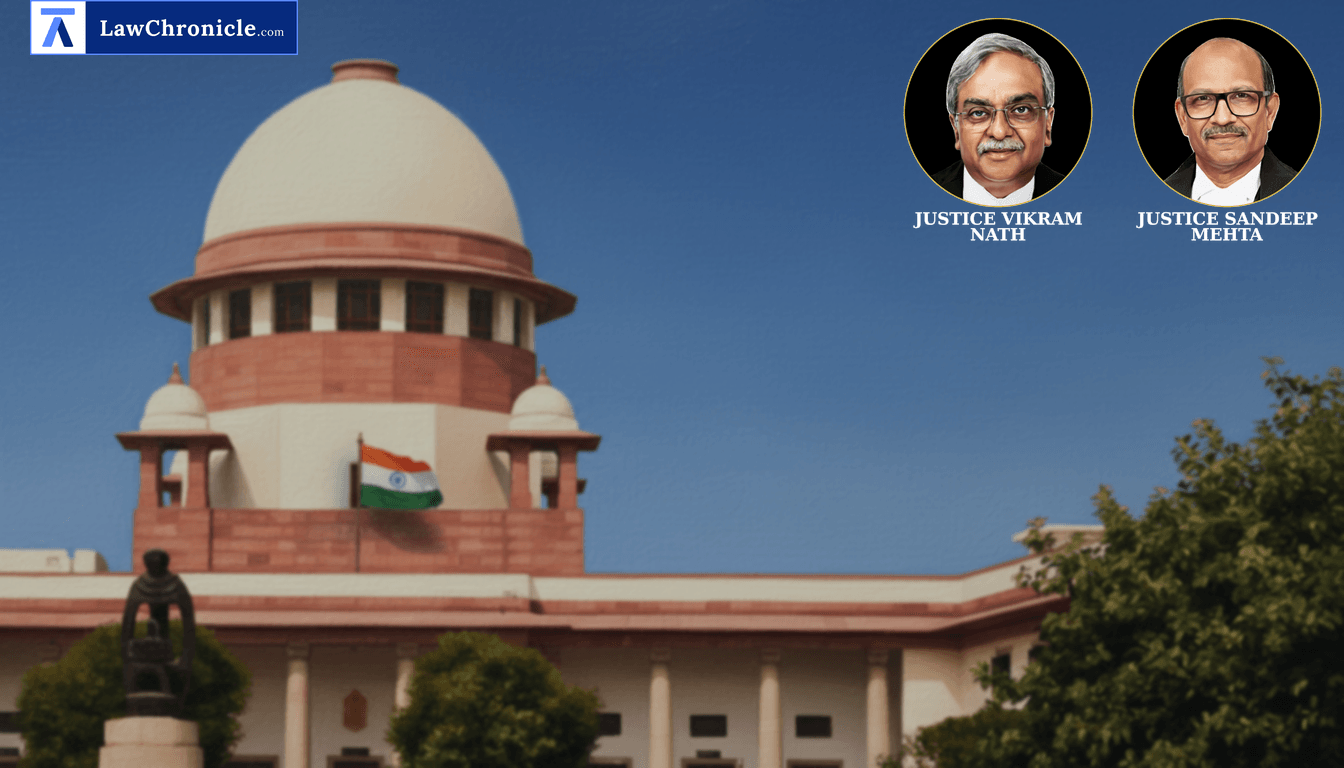
The Supreme Court of India set aside the “Gang Labourers (Employment for Sporadic Types of Work) Scheme, 2012” as invalid to the extent that it conflicts with the Tribunal’s directions mandating permanent engagement, and directed the Central Government to regularise the appellants’ services and grant them permanent status with effect from 9 September 2010.
A Bench of Justice Vikram Nath and Justice Sandeep Mehta heard an appeal challenging the validity of the “Gang Labourers (Employment for Sporadic Types of Work) Scheme, 2012” and the respondents’ refusal to regularise long‑service daily‑wage workers engaged at the Mahendragiri Unit of the respondent‑Centre.
The Court allowed the appeal and set aside those parts of the Scheme that were inconsistent with earlier directions of the Tribunal, and directed regularisation of the appellants with effect from 9th September, 2010 within four weeks. The Court noted that the Tribunal’s order of 9th March, 2010 had required creation of posts and engagement on a permanent footing while balancing security concerns.
The Court, in its reasoning, observed: "Thus, the essence of the directions issued in the earlier round of litigation was to bring about a transition from an ad hoc, daily-wage arrangement to a structured regime founded upon duly created posts within a stipulated time frame. Any scheme that falls short of this requirement, by merely regulating engagement without providing for such post creation, cannot be said to be in compliance with the letter and spirit of the said directions."
The Court also reproduced the Tribunal's factual findings, quoting that "the applicants have no right to claim regularization of their services simply because they have been engaged for-a-period ranging from 14 to 26 years" while simultaneously recording the Tribunal's view that continuous engagement evidenced availability of regular work. The Court concluded that the Scheme’s provisions for mere temporary engagement diluted the final judicial mandate and therefore set those provisions aside.
Background
The dispute arose out of the engagement of 34 gang labourers for sporadic tasks such as loading, unloading and shifting of materials at the Mahendragiri Unit, a research facility that was declared a prohibited area under the Official Secrets Act, 1923. The appellants were engaged between 1991 and 1997 and had repeatedly sought regularisation. The Tribunal first directed on 9th March, 2010 that the respondents frame a scheme or ad‑hoc rules, creating requisite posts and considering preferential treatment for long‑serving labourers, within six months. Challenges to that direction were dismissed by the High Court and this Court in the earlier round, after which the respondents framed the Gang Labourers Scheme on 3rd September, 2012. The appellants contended that the Scheme contravened the Tribunal’s final mandate and that continued daily‑wage engagement offended Article 23 of the Constitution of India, 1950. The respondents maintained that the work was sporadic, no regular posts existed, and the Scheme complied with the Tribunal’s directions while addressing security imperatives at a campus declared under the Official Secrets Act, 1923.
The High Court, while upholding the Scheme, relied upon precedent to hold that there was no fundamental right to absorption, referring to State of Karnataka v. Umadevi ( "(2006) 4 SCC 1": 2006 CaseBase(SC) 148), and observed that long ad hoc engagement alone did not automatically entitle workers to regularisation. The Supreme Court held that the scope of the subsequent writ proceedings was confined to examining compliance with the Tribunal’s final directions and that the High Court had impermissibly re‑opened merits it could not revisit. The Court emphasised Article 14 of the Constitution of India, 1950 as imposing a duty upon the State to act as a model employer and to eschew arbitrariness in service matters, particularly where national security considerations under the Official Secrets Act, 1923 were invoked to justify deviation from judicial directions. In consequence, the Court set aside Clause 2 of the Scheme and directed that the appellants be regularised with retrospective effect from 9th September, 2010; the benefit of the judgment was declared to enure to all similarly situated persons.
Case Details:
Case No.: SPECIAL LEAVE PETITION (CIVIL) NO. 7138 OF 2025
NeutralCitation: 2026 INSC 431
Case Title: R. IYYAPPAN & ORS. v. UNION OF INDIA & ORS.
Source: 2026 CaseBase(SC) 372
 Breaking News