


Union Budget 2026–27: Key Highlights
 Copy Link
 Share
Share Save
Save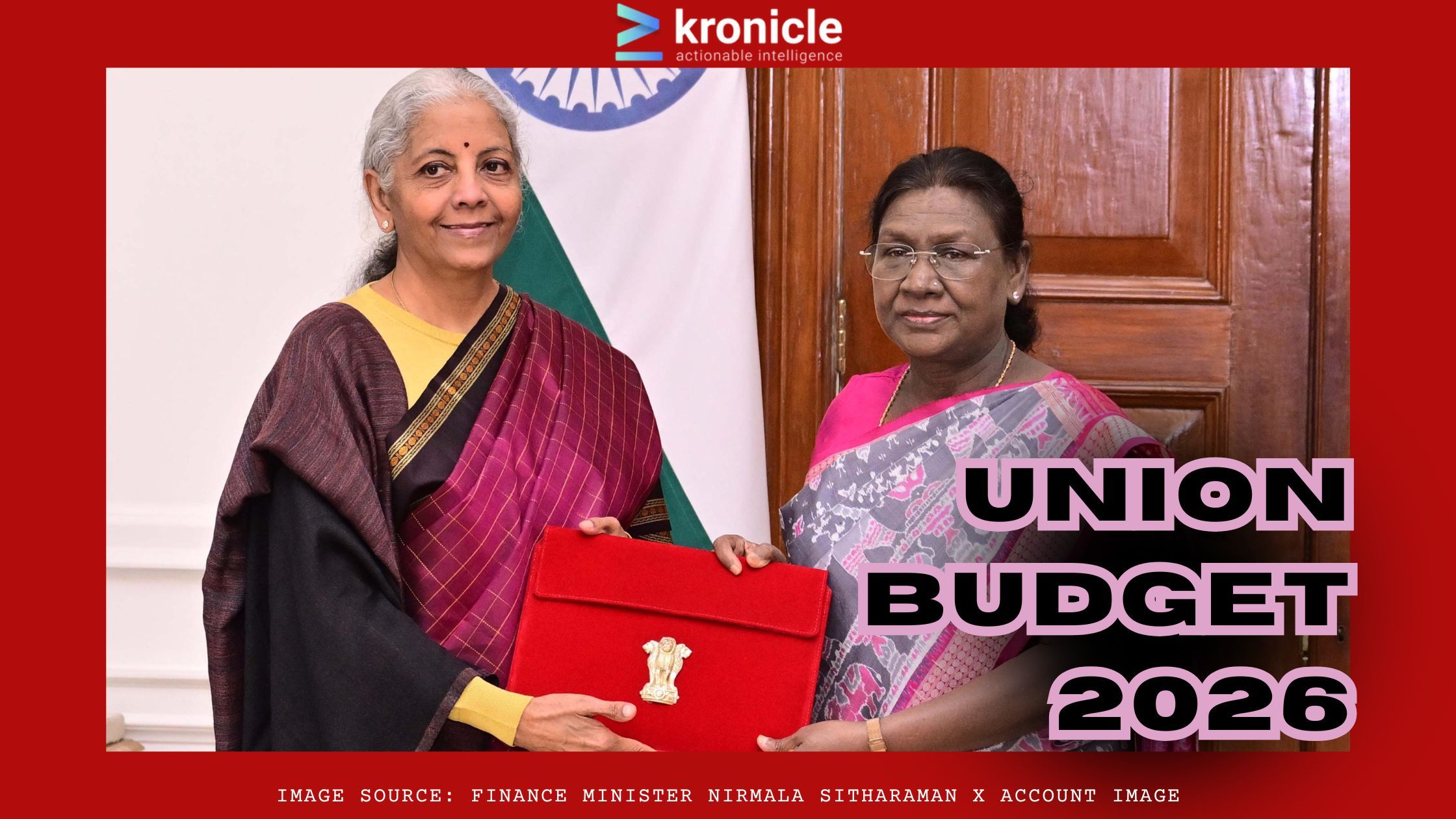
Finance Minister Nirmala Sitharaman on 1st February, 2026 presented the Union Budget 2026–27. The Budget focuses on long-term structural reforms rather than short-term populist measures, aiming to make India a strong, resilient, and globally competitive economy. The “Yuva Shakti-driven” budget purportedly focuses on poor, underprivileged and disadvantaged sectors.
The Three Kartavyas
As termed by her, the 2026 Budget is guided by three central duties or kartavyas:
- To accelerate and sustain economic growth, by enhancing productivity and competitiveness, and building resilience to volatile global dynamics;
- To fulfil aspirations of the people and build their capacity, making them strong partners in India’s path to prosperity;
- Sabka Sath, Sabka Vikas to ensure that every family, community, region and sector has access to resources, amenities and opportunities for meaningful participation.
Let us dive deeper into the highlights of today's Union Budget.
1. Fiscal Position and Budget Estimates
For 2026–27, non-debt receipts are estimated at ₹36.5 lakh crore and total expenditure at ₹53.5 lakh crore. Net tax receipts are projected at ₹28.7 lakh crore. The fiscal deficit is estimated at 4.3 per cent of GDP, slightly lower than the revised estimate of 4.4 per cent for the previous year. The debt-to-GDP ratio is projected to decline marginally, indicating continuation of fiscal consolidation while maintaining capital expenditure at elevated levels.
2. Manufacturing and Industrial Policy Measures
The Budget outlines a strategy to expand domestic manufacturing across select strategic and frontier sectors. New initiatives have been announced in biopharma, semiconductors, electronics components, textiles, chemicals, and capital goods. These include the Biopharma SHAKTI programme, Semiconductor Mission 2.0, and dedicated industrial corridors and parks.
Measures related to industry include:
- Establishment of new pharmaceutical research institutes and clinical trial networks
- Support for domestic production of electronics, containers, and construction equipment
- Revival of 200 legacy industrial clusters through infrastructure and technology upgrades
Small and medium enterprises are addressed through the proposed SME Growth Fund and continued funding for micro enterprises. Skill-oriented support through professional institutions has also been proposed.
3. Infrastructure, Transport and Energy
Public capital expenditure has been increased to ₹12.2 lakh crore for 2026–27. Infrastructure development focuses on transport, logistics, and urban connectivity. New freight corridors, national waterways, coastal shipping incentives, and high-speed rail corridors have been announced to improve movement of goods and passengers.
Key proposals include:
- Infrastructure Risk Guarantee Fund to address project-phase risks
- Expansion of inland waterways and coastal cargo share
- Investment in carbon capture, utilization and storage technologies
Urban development is addressed through City Economic Regions, funded through a challenge-based and performance-linked mechanism.
4. Human Capital, Services and Social Sectors
The Budget proposes measures to strengthen linkages between education, skills, and employment, particularly in services. Expansion of allied health professionals, veterinary education, medical tourism hubs, and AYUSH institutions form part of the health-related initiatives.
Education, tourism, culture, and creative industries receive policy attention through university townships, hostels for women, heritage site development, and support for creative technology labs. Sports development is addressed through the Khelo India Mission.
5. Agriculture, Regional Development and Inclusion
Agricultural initiatives focus on water resource management, promotion of high-value crops, and digital advisory services through the proposed Bharat-VISTAAR platform. Targeted measures are proposed for Divyangjan skill development and mental health infrastructure. Special attention is given to eastern and north-eastern states through industrial corridors, tourism projects, and transport support.
6. Tax Reforms and Compliance Measures
The new Income Tax Act, 2025 effective from April 2026, aims to simplify tax provisions and procedures. Changes include rationalisation of TDS and TCS rates, simplified return filing, extended timelines for revisions, and reduced criminal liability for certain defaults. Sector-specific tax measures have been introduced for IT services, global investors, exporters, and cooperatives. Indirect tax changes focus on tariff simplification, customs process reforms, and facilitation of exports.
7. Orange Economy
The 2026 Union Budget seeks to support Indian Institute of Creative Technologies, Mumbai by setting up, Visual Effects, Gaming and Comics (AVGC) and Content Creator Labs in 15,000 secondary schools and 500 colleges.
Conclusion
The Union Budget 2026–27 outlines policy measures across fiscal management, industrial development, infrastructure, human capital, and taxation. By focusing on long-term reforms and capacity building, the Budget seeks to lay a strong foundation for India’s journey towards becoming a developed nation.
Source: PIB
 Breaking News